The Fugitive

Revealing mistake: When Kimble jumps from the dam, the falling body is clearly a dummy, otherwise he broke every single bone in his body before he even jumped.

Revealing mistake: During the St. Patrick's Day parade, Kimble removes his coat. In the next scene, he hasn't got the coat anymore, and he HASN'T dropped it. Don't be fooled. If you look to his right in the scene just after he takes it off, you can see a man carrying a coat that is the exact same colour and design. I assume this guy is supposed to be hiding the coat from view, but you can plainly see it. The guy is wearing a green hat. Kimble had no time to give it to him before the scenes changed. (01:23:25)

Revealing mistake: Just after the opening murder scene, there's a shot of a Chicago Police van responding with blue lights flashing. If you look closely at the roof lights between the beacon on the right side of the roof you can see a sign "FILM2" stuck to the bar. (00:01:55)

Revealing mistake: When the movie begins and Kimble is questioned by the cops, the blood on his T-shirt remains red, instead of dark red or brown due to oxidation.

Sacha

The Fugitive mistake picture

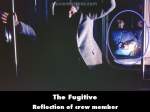
Visible crew/equipment: After Sykes shoots the Transit Cop on the "L" Richard pulls the emergency brake, and in the following shot facing Richard as the train screeches in flashes of darkness, the reflection of a crew member quickly becomes visible on the glass window beside Richard. (01:47:45)

Super Grover

More mistakes in The Fugitive

Richard Kimble: Do you remember what I told you in the tunnel?
Sam Gerard: Um, yeah. It was noisy, I think you said something like you didn't kill your wife.
Richard Kimble: Remember what you told me?
Sam Gerard: I remember you pointing my gun at me.
Richard Kimble: You said "I don't care."
Tracing tech: He's on the south side.
Sam Gerard: Yeah. Yeah, that's right, Richard. I don't care. I'm not trying to solve a puzzle here.
Richard Kimble: Well, I *am* trying to solve a puzzle.
Cosmo Renfro: Five seconds to location.
Richard Kimble: And I just found a *big* piece.

More quotes from The Fugitive

Trivia: After his escape, it shows Harrison getting on a train marked with the name "Kimball" and then in the next shot, a helicopter flies over a hotel called "Harrison".

More trivia for The Fugitive

Question: Towards the end, before the confrontation with Kimble and Nicholls, the guy who was tracing Kimble's phone records tells the Marshalls that Kimble telephoned Sykes on the night of his wife's murder. But obviously it wasn't Kimble calling Sykes, it was Sykes using Kimble's phone. But why would Sykes be calling himself?

jenn_s_h85

Chosen answer: He didn't. A key plot point is that Nichols borrowed Kimble's car on the night of the murder. The call to Sykes, which is expressly stated by the marshals as being on Kimble's car phone, was from Nichols, presumably arranging to meet so that he could give Sykes Kimble's keys to get into his house to lie in wait for him.

Tailkinker

Thank you for explaining it. I've seen it several times and never realised how it went down.

And Tommy Lee Jones tells Kimble that they knew Nichols called Skyes from his car, but how? Wouldn't the more logical answer have been that the US Marshals thought that Kimble called Sykes from his car to tell the killer his wife was home alone? There is no way the US Marshalls would have known that the Kimble let Nichols borrow his call - that's the mistake in the movie! It actually should have made the Marshalls suspicious of Kimble, not exonerate him.

The Marshals know Kimble let Nichols borrow his car because Kimble told the police when he was initially interviewed following the murder. He gave a detailed account of his actions and whereabouts that night and mentioned that Nichols had borrowed his car. It didn't seem suspicious to the police at the time because Richard claimed he fought with a one armed man he didn't recognize; a story the police did not believe because there was no evidence of this and Kimble's wife "identified" her attacker as Richard. Gerard puts everything together when he realises that Nichols lied about knowing Lentz.

BaconIsMyBFF

How did Sam figure out that Nichols borrowed the vehicle and made the call to Sykes and gave him keys, etc? I know in the laundry he reveals that he knew this but when/how did he figure it out?

Ok, so why didn't Kimble's lawyer use this information? It would make no sense for Kimble to call Sykes; they could've solved the case easily if they had actually done some digging and not thrown Kimble under the bus.

Answer: This is more of a question really. What kind of defense attorney did this high dollar, Dr. Kimble hire who do not show their defendant pictures of the one-armed men the police question? How do his attorneys not ask him "OK, which of these one-armed men did you fight with in your house?"

The prosecution is not required to inform the defense of every person the police interview or question. They are only required to give the defense whatever evidence they have against the accused. Simply questioning someone in a perceived dead only counts as evidence against the accused if the prosecutor mentions it in court. If the prosecutor were to say "We interviewed a one-armed man named Sykes and he says he doesn't know you", then Kimble's defense would be required to be given access to Sykes. We can assume this never happened.

BaconIsMyBFF

Yes, but what about the phone call made from the phone in Kimble's car to Sykes on the night of his wife's murder? It's said that Kimble gave the car to Nicholls, and it would make no sense for Kimble to call Sykes.

The Chicago police DID question Sykes after the Kimble murder. Review the scene where Sykes returns to his apartment after Kimble has been there. Girard starts asking Sykes questions, at first Sykes says he doesn't know anything about Kimble but then "remembers" that he had been interviewed by the police right after the Kimble murder. However, Sykes says that he gave the police an alibi, with 15 people supposedly confirming that Sykes was on a business trip and not in Chicago. The movie then implies that Sykes had been a Chicago cop and lost his arm "in the line of duty." Remember that the Chicago police focused on Kimble pretty quickly. Their investigators may have interviewed Sykes, but they likely didn't even come close to considering him as a potential murderer. Even with Sykes likely matching Kimble's description of the one-armed man, the police likely saw Sykes as a former cop... A former cop who had an alibi confirmed by 15 people. As I understand it, prosecutors don't have to tell defense attorneys about everyone that the cops question. They only have to tell the defense about potential witnesses that might be called in connection to the criminal trial. In this scenario, Sykes wouldn't have been part of the criminal trial (Again, supposedly on a business trip confirmed by 15 people on the night of the murder) and thus Kimble and his lawyers would never have known about his existence.

More questions & answers from The Fugitive